AD CAMPAIGNS, WITH THE REASONING SHOWN
It writes the ad.
Then it tries to prove you wrong.
AdPlaybook turns a product page into a complete, buildable ad campaign — strategy, audiences, exclusions, copy, test matrix, measurement plan — then attacks its own work before it shows you anything.
v0.2.53 · 134.7 MB · Apple Silicon · macOS 26 or later · notarised by Apple
- 1Read 6 pages · 116 spans · quality 1.00
- 2Brief what is provably true about the product
- 3Generate 3 variants, one axis apart
- 4Claim gate 1 blocked — a price it could not trace
- 5Review REJECT — 2 blockers
- 6Guide 15,884 bytes, in build order
VARIANT B — what it wrote
All-in-one client management.
Save up to 20 hours every week. Manage clients, projects, and payments in one place.
VARIANT C — blocked before anyone saw it
All-in-one client management.
Manage every client, project, and payment all in one place. Starting at $29/month.
blocked by the claim gate The price appears nowhere it could verify.
THE REVIEW PASS — verdict
REJECT — 2 blockers, 1 serious.
On Variant B: "Meta will reject the ad for unqualified performance claims… Rewrite the benefit to use unqualified language such as 'Save time every week'."
And a strategy error nobody asked it about: optimising for Purchase on a 7-day window for a $29/month product means 50 conversions is unreachable, so "the algorithm will never exit the learning phase and the test will yield no real results to judge the variants."
It also said what was good: "the exclusion strategy correctly identifies the need to exclude existing customers."
Two separate mechanisms caught the same fabricated claim without being told to agree — the claim gate blocked the price, and the review pass flagged it independently. That is the whole design working, on a site we do not control.
Every other tool in this category would have handed you all three variants.
Before you spend anything
It knows what will quietly fail
The expensive failures in paid media do not produce an error. These are checked by arithmetic against each platform's published limits, on every campaign, for free:
It separates the platform will refuse this from this will be cut off, because those need different reactions — and it tells you what it could not check, so an empty warning list never reads as a clean bill of health.
Strategy, not just words
Ten approaches, each with its failure mode stated first
Direct response burns your warmest audience first. Community-native gets read by people who will argue in the replies. Retargeting recovery pays you for sales you were going to make anyway unless you hold out a control group.
You are told all of that before you choose, because the expensive mistakes in advertising are strategic, not typographical. AdPlaybook reads your site, works out what you sell and to whom, and recommends the approach that fits your price, your sales cycle and your competition — then explains what it costs you.
8 platforms
Held as dated facts, not folklore
Google Ads, LinkedIn, Meta (Facebook and Instagram), Pinterest, Reddit, TikTok, X and YouTube. Every character limit, aspect ratio and hard floor quoted from the platform's own documentation, with the date it was read — and an explicit list of what could not be verified.
Get it
Mac, Apple Silicon. Signed, notarised and stapled — it opens without a Gatekeeper warning because Apple's notary service cleared it, not because you right-clicked past one.
Download free for Mac · 134.7 MB Buy a licence · $149 once
Paying for it
$37.25 × 4, then it stops, and it is yours
AdPlaybook is $149 once. If that is easier as four payments, Klarna and Afterpay split it into $37.25 every two weeks — the last one 6 weeks after the first, at no extra cost.
It is the opposite of how this category bills. Every other ad tool charges you monthly for as long as you use it, and the day you stop paying you stop having it. Here the payments end and the licence does not: unlimited commercial use, on every site you work on, with no renewal to forget and nothing to cancel.
Availability depends on where you are and is decided by the provider at checkout, not by us. Klarna covers the US and 19 European countries; Afterpay covers the US and UK.
30 days to change your mind. If it does not do what you need, email within 30 days of purchase and we refund in full — no reason required, back to the original payment method. One refund per customer, and the full policy is in the terms.
Free to download and use — the whole app, no credits, no watermark, no account. $149 once buys a licence for unlimited commercial use across every site you work on. No subscription and no renewal.
v0.2.53 · All releases · bring your own OpenAI or Anthropic key, or run every generation locally with Outlier
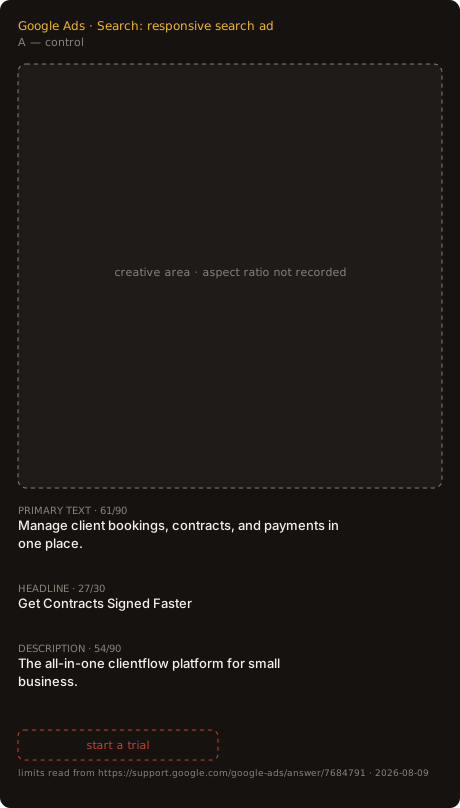
a-control-preview.svg — this is the file, not a picture
of it.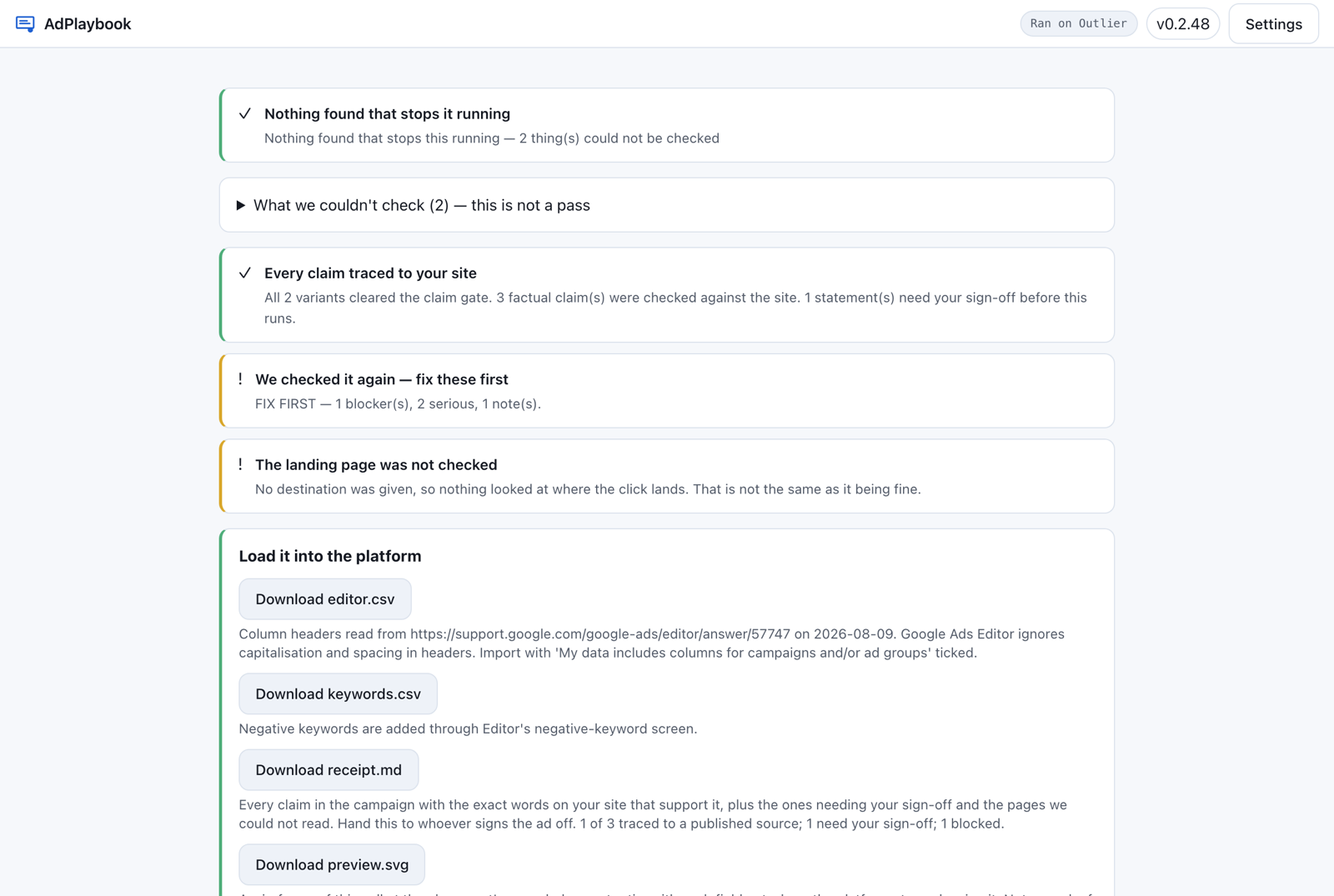
A real run, not a mockup. Verbatim output from pointing AdPlaybook at HoneyBook's website. It wrote three ad variants, then a second model was asked to find the reason the campaign fails. Nothing here is illustrative.
Try the claim gate
Paste an ad claim. Watch it get checked.
This is the real gate — the same thirteen patterns the app runs, exported from the engine, not a reproduction. Nothing is sent anywhere; it runs in this page.
A claim it cannot trace to your own page is blocked before it reaches an ad account. That is the whole product; this is it running.
What it has actually done
Three of these four are failure rates
Measured across 61 real businesses — every one a live crawl through a real model, not a demo. Most tools publish the number that flatters them. These are the ones that do not.
14/61
campaigns its own review refused
It argues with itself before it argues with you.
17/61
sites it could not read — and said so
Bot protection is common. Inventing a business is not an option.
3/61
flagged as reading machine-written
Counted, not guessed. A model cannot judge its own register.
61/61
shipped with every claim traced
Each line of copy against the page it came from, or marked unproven.
Derived at build time from the run corpus. scripts/sweep_report.py reproduces every figure.
The part nobody else does
It refuses to write things it cannot back up
An ad that says "60-minute callouts" has to point at the page that says it. AdPlaybook harvests the exact words from your own site and blocks any figure that is not there. Recombine two true statements into a third one nobody actually made, and it flags that for your sign-off instead of quietly shipping it.
You get an evidence receipt: every claim beside the URL and verbatim quote behind it — plus the ones needing sign-off, the ones that were blocked, and the pages it could not read. It is built for whoever signs the ad off and carries the liability for it.
Run against ourselves
We pointed it at this website
Everything above describes what the gate does. This is it doing it — to an ad for AdPlaybook, checked against AdPlaybook’s own site, which you are reading and can go and check yourself.
Fix: Cut 45 characters to keep all of it visible.
Fix: Cut 59 characters to keep all of it visible.
A — CONTROL
Every claim, checked against your own site
AdPlaybook turns a product page into a complete ad campaign — strategy, audiences, exclusions, copy, a test matrix and a measurement plan — then attacks its own work before it shows you anything.
B — THE SPECS AXIS
Eight platforms, every number quoted
Ad specs go stale and the pages ranking for them are wrong. AdPlaybook reads each platform's own published limits and checks your copy against them by arithmetic, before you paste anything into an ads manager.
C — THE PERFORMANCE AXISblocked
Cut your cost per click by 62%
AdPlaybook writes 40 tested variants in 9 seconds and cuts cost per click by 62% on average. Start your free trial today and see results in the first week.
WHAT IT COULD NOT CHECK
- Whether the audience clears LinkedIn's minimum of 300. This campaign splits into 3 cell(s), so the audience needs to be at least 900 for every cell to deliver. Check the forecast in LinkedIn Campaign Manager before launching.
- Whether the ad complies with the platform's advertising policies. This checks sizes and limits only — it is arithmetic, not a policy review.
An empty warning list has to mean “checked and clean”, never “did not look”. This is the part every other tool leaves out, and it is the reason to believe the rest.
Who wrote what. The three variants were written
by hand, here, so the specimen does not change between builds. Every verdict
under them was not: they come from adkit.gate and
adkit.feasibility, the same modules the app runs, against a live
crawl of this site that read 65 spans.
Produced on 2026-08-17 against AdPlaybook
0.2.45. _build/selfcheck.py reproduces it.
One page was held out, and here is why. The crawl behind this skips this page. It has to: the section you are reading quotes variant C word for word, so the next crawl read those sentences back off our own site and cleared all three variants — the invented claims had become true statements about the page that printed them. Every other page was read, which is why “Eight platforms” still resolves: it lives on /for/agencies/ and was there long before this existed. A check that reads what it just wrote is checking itself.
What it deliberately does not do
It does not make the image or the video. What it produces is a brief specific enough to hand to a designer or a creative generator — if the asset is what you need, buy one of those and feed it this.
It does not predict performance. A conversion score on an ad that has never run is a guess in the typography of a metric, and this tool does not publish numbers it did not measure. In a demo that looks like a missing feature. It is the reason to believe everything else it tells you.